Aug 6, 2026
Hugo Walker

If your customer service team spends hours every day manually entering orders from emails, phone calls and PDFs into your ERP, you're not alone.
For many food manufacturers, this has simply become "the way we've always done it."
But as order volumes increase, manual processes quickly become a barrier to growth. Every new customer means more admin, more opportunities for errors and greater pressure to recruit additional customer service staff.
A best-in-class B2B ordering platform changes that.
By digitising and automating the ordering process, manufacturers can process more orders, improve customer experience and grow without increasing headcount.
In this guide, we'll explain exactly what a B2B ordering platform is, how it works, why it's becoming essential for food manufacturers and what to look for when choosing one.
What is a B2B ordering platform?
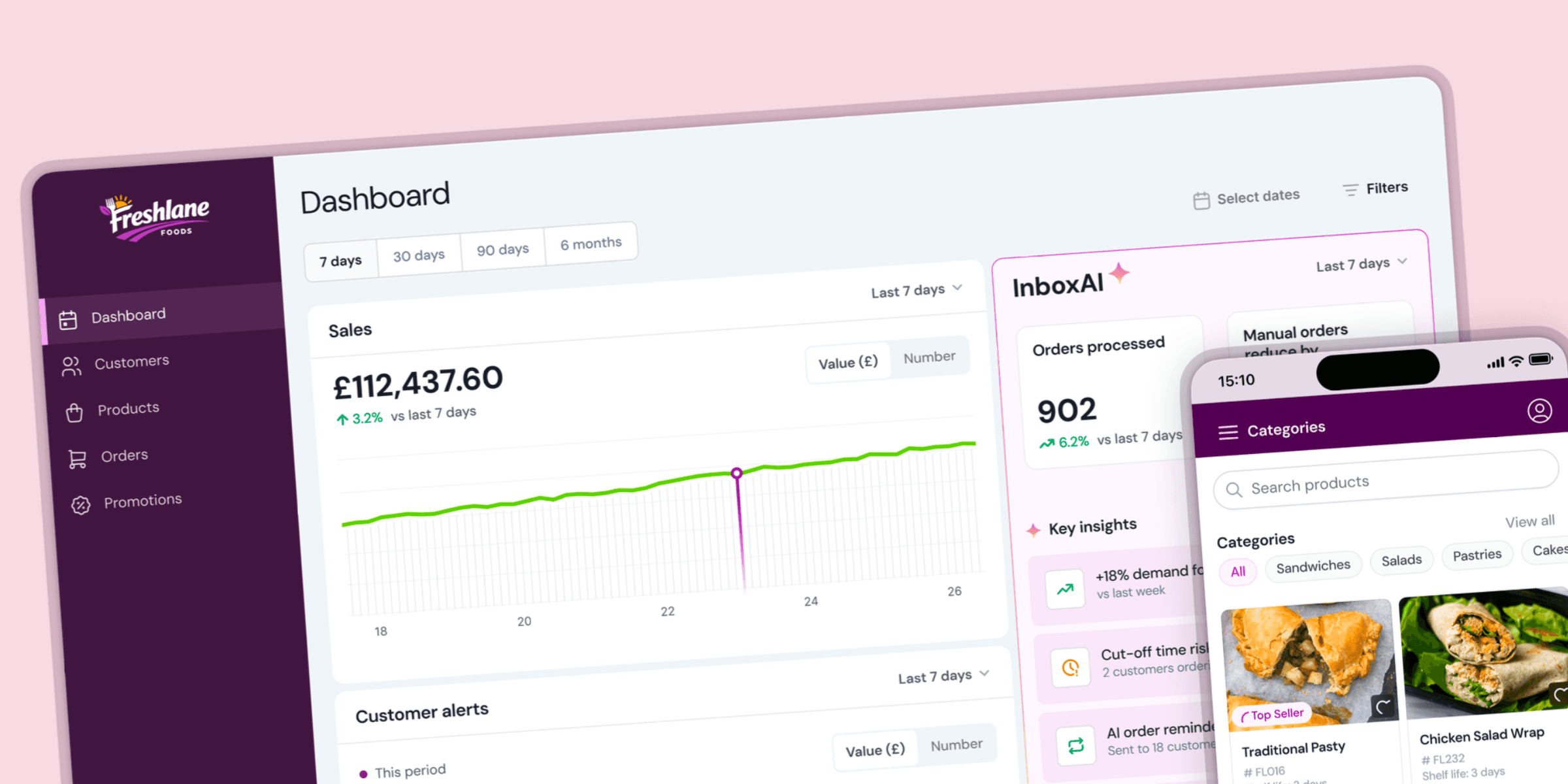
A B2B ordering platform is software that allows wholesale customers to place orders digitally while automating the flow of those orders into your internal systems.
Think of it as the connection between your customers and your ERP.
Rather than relying on emails, phone calls and manual order entry, customers can place orders online through a secure portal that reflects their agreed pricing, product range and delivery arrangements.
For manufacturers, those orders flow directly into production and fulfilment workflows without the need for manual rekeying.
The result is faster order processing, improved accuracy and a better experience for both customers and internal teams.
Is a B2B ordering platform the same as B2B eCommerce software?
Not quite.
While the terms are often used interchangeably, they're designed to solve different problems.
Traditional B2B eCommerce platforms focus primarily on selling products online.
A B2B ordering platform is designed around the operational realities of managing ongoing trade customer relationships.
Food manufacturers rarely operate like a standard online retailer.
Customers have negotiated pricing, standing orders, delivery schedules, cut-off times, product restrictions and complex account structures that need to be reflected every time an order is placed.
The platform isn't simply a digital catalogue; it's an extension of your operational processes.
Why do food manufacturers need a specialist ordering platform?
This is where many generic B2B eCommerce solutions begin to fall short.
Food manufacturing has operational requirements that don't exist in most other industries.
For example, manufacturers often need to manage:
Customer-specific pricing and product availability
Delivery day rules and ordering cut-off times
Minimum order values and delivery constraints
Variable-weight or catchweight products
Standing orders and recurring deliveries
Seasonal product availability
ERP-specific business rules
EDI alongside online ordering
Multiple buying locations under one customer account
Trying to customise a generic commerce platform to handle these requirements can become expensive, complex and difficult to maintain.
A food-specific B2B ordering platform is built around these business rules from the outset.
Instead of forcing manufacturers to change how they operate, it supports the processes they already rely on while automating them.

How does a B2B ordering platform work?
Although platforms differ, the overall process is straightforward.
Customers log in to a branded ordering portal where they see only the products, pricing and delivery options available to them.
As orders are placed, the platform automatically validates them against your business rules before sending approved orders directly into your ERP.
Those rules might include:
Delivery cut-off times
Customer-specific pricing
Minimum order quantities
Product availability
Delivery schedules
Credit limits
Promotional pricing
This significantly reduces manual intervention.
What are the benefits of a B2B ordering platform?
The impact goes far beyond simply allowing customers to order online.
Reduce admin burden
Customer service teams spend less time manually entering orders and correcting mistakes, freeing them to focus on customer relationships and proactive account management.
Improve order accuracy
Removing manual data entry reduces the risk of incorrect quantities, missed product codes and pricing errors.
Deliver a better customer experience
Customers can place orders whenever it's convenient, quickly reorder previous purchases and receive immediate confirmation that their order has been accepted.
Increase operational visibility
Every order follows a consistent digital process, giving commercial and operational teams better visibility of demand and customer activity.
Scale efficiently
Perhaps the biggest benefit is being able to process significantly higher order volumes without proportionally increasing headcount.
What features should food manufacturers look for?
Not all B2B ordering platforms are created equal.
When evaluating solutions, manufacturers should look beyond the customer portal itself.
The strongest platforms combine customer self-service with automation across the entire ordering process.
Key capabilities include:
Customer-specific pricing
ERP integration
Delivery scheduling and cut-off management
Order templates and repeat ordering
Live product availability
Standing order management
EDI connectivity
Mobile-friendly ordering
Order approvals and business rule validation
Reporting and customer insights
Increasingly, manufacturers should also consider AI capabilities.

How is AI changing B2B ordering?
Artificial intelligence isn't replacing customer ordering. It's making every ordering channel more efficient.
While online ordering portals remain essential, some customers will continue ordering by email or sending PDF purchase orders.
Modern B2B ordering platforms increasingly use AI to automate these processes too.
For example, AI can:
Read emailed purchase orders automatically
Extract data from PDFs
Validate orders before they're processed
Flag potential errors or unusual ordering patterns
Send intelligent order reminders to reduce missed orders
This means manufacturers can automate far more of their order processing without forcing customers to change how they buy.
Rather than replacing existing ordering methods, AI complements them.
Why integration matters
Even the best ordering platform delivers limited value if it sits outside the rest of your business.
The real benefits come when orders move seamlessly into your ERP without duplicate data entry.
Integration ensures:
Customer records stay synchronised
Pricing remains accurate
Stock availability is reflected correctly
Orders reach production immediately
Finance receives accurate information for invoicing
A truly integrated platform becomes part of your existing operation rather than another system your team has to manage.
How do you know it's time to invest?
Many manufacturers recognise the signs.
Your customer service team spends hours processing orders manually.
Order volumes are increasing faster than your administration team can cope.
Errors are becoming more frequent.
Customers are asking for online ordering.
Recruiting more customer staff feels like the only way to grow.
These are all indicators that your ordering process has become a constraint rather than a competitive advantage.

Why food manufacturers choose mezzeIQ
At mezzeIQ, we believe a B2B ordering platform should do much more than provide an online portal.
It should automate the entire ordering process while respecting the complexity of food manufacturing.
That's why mezzeIQ has been built specifically for the sector.
Our platform supports customer-specific business rules, integrates with leading ERP systems and allows customers to order in the way that suits them best, whether through a branded ordering portal, EDI or other connected channels.
Alongside these capabilities, AI helps automate traditionally manual tasks such as processing emailed purchase orders and reducing missed orders, allowing manufacturers to improve efficiency without disrupting customer relationships.
The result is a single platform that helps food manufacturers reduce admin, improve accuracy, enhance customer experience and scale without adding headcount.
The future of B2B ordering
The most successful food manufacturers won't be those with the biggest customer service teams.
They'll be the ones that remove friction from the ordering process.
A modern B2B ordering platform isn't simply about selling online.
It's about embedding your business rules into every order, integrating seamlessly with your operational systems and giving customers the flexibility to buy how they prefer.
For manufacturers looking to grow without adding unnecessary administration, it's rapidly becoming an essential part of the technology stack.
Contact mezzeIQ today to discover how a best-in-class B2B ordering platform can transform your food manufacturing business.